

Truck Accident Lawsuit Loans: How They Work and What They Really Cost
Content Outline
- Introduction – the financial gap after a truck accident
- What Is a Truck Accident Lawsuit Loan?
- How Truck Accident Lawsuit Loans Work (Step-by-Step)
- Who Typically Qualifies?
- Average Truck Accident Settlement Amounts in the US
- Interest Rates and Real Costs to Expect
- Are These Loans Regulated? A State-by-State Snapshot
- Pros and Cons (Balanced View)
- Alternatives Worth Considering
- FAQ Section
- Closing Thoughts
Truck Accident Lawsuit Loans: How They Work and What They Really Cost
A serious truck accident can turn daily life upside down in seconds. Medical bills pile up, paychecks stop coming in, and the lawsuit against the trucking company or insurer can take months — sometimes years — to resolve. This gap between the accident and the final settlement check is exactly why “truck accident lawsuit loans” have become such a common search term across the US. Read More: truck accident loans
This guide breaks down what these products actually are, how they work, what they cost, and what the law says in different states — without any sales pitch. The goal is simple: give you the facts so you can make an informed decision with your attorney.
What Is a Truck Accident Lawsuit Loan?
Despite the name, a truck accident lawsuit loan isn’t a loan in the traditional banking sense. It’s more accurately described as pre-settlement funding — a cash advance based on the expected value of a pending truck accident lawsuit.
A funding company reviews the strength of your case (liability, injuries, insurance coverage) and, if approved, advances you a portion of the anticipated settlement. You get cash now; the funding company gets repaid later, directly out of the settlement, if and when the case resolves in your favor.
The defining feature of almost all these products is that they’re non-recourse. That means if you lose your truck accident case, you generally don’t owe anything back. The funding company absorbs that risk, which is also why the fees tend to run higher than a standard personal loan.
How Truck Accident Lawsuit Loans Work

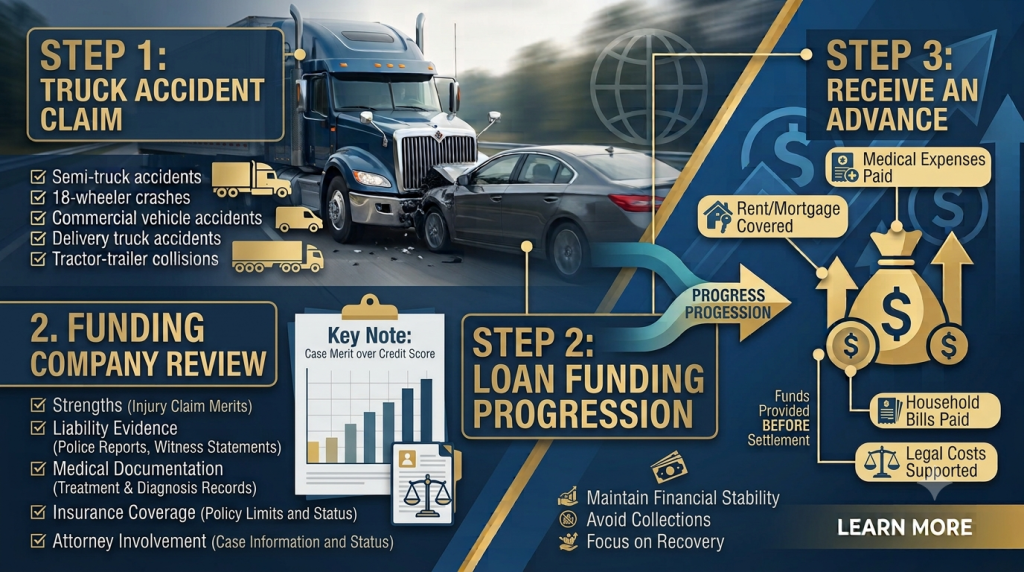
The process across most lawsuit funding companies in the US follows a similar pattern:
- You (or your attorney) apply. You provide basic case details — accident report, medical records, and your attorney’s contact information.
- The funding company evaluates the case. They’re not looking at your credit score or job history. They’re assessing liability, the severity of your injuries, and how much insurance coverage the trucking company carries.
- Your attorney confirms case details. Since truck accident lawsuits often involve multiple parties (the driver, the trucking company, and sometimes a cargo loader or maintenance contractor), attorney verification is a required step.
- Funds are disbursed. If approved, money is typically sent within 24 to 48 hours, either by direct deposit or check.
- Repayment happens at settlement. If you win or settle, the advance plus fees is deducted from your payout before you receive the remainder. If you lose, non-recourse terms usually mean you keep the cash and owe nothing.
Who Typically Qualifies?

Because approval is based on the lawsuit itself rather than your personal finances, funding companies generally look for:
- An active lawsuit filed against the trucking company, driver, or insurer
- Representation by a personal injury attorney working on contingency
- Documented injuries with medical records supporting the claim
- Clear evidence of liability (police reports, driver logs, black box data, or safety violations)
- Sufficient insurance coverage on the defendant’s side to make the settlement collectible
Because commercial trucks are required to carry higher insurance minimums than personal vehicles, truck accident cases often qualify for larger advances than a typical car accident claim — assuming liability is clear.
Average Truck Accident Settlement Amounts

Settlement values vary enormously depending on injury severity, lost wages, and the trucking company’s insurance limits. Reported industry figures put the average truck accident settlement at just over $100,000, though outcomes range from a few thousand dollars for minor injury claims into the multi-million-dollar range for catastrophic injury or wrongful death cases involving large commercial carriers.
Because federal law requires interstate trucking companies to carry higher minimum liability insurance than passenger vehicles (often $750,000 to $1 million or more), truck accident settlements tend to run higher on average than standard car accident claims — which is one reason funding companies are often willing to advance larger amounts for these cases.
Interest Rates and Real Costs to Expect
This is the part most funding company websites gloss over. Because pre-settlement funding is non-recourse and unregulated in many states, pricing varies widely:
- Reputable funders often quote simple interest rates in the 15%–20% range, though this can compound depending on contract terms.
- Some reports on the broader legal funding industry cite advances with effective annual costs exceeding 100% when fees compound over a long case timeline, which is why consumer advocates have pushed for stricter disclosure rules.
- Funding amounts are usually capped at 10% to 20% of the expected settlement value, since attorney fees (commonly 33%–40% under contingency arrangements) and case costs also come out of the final number.
- The longer a lawsuit takes to resolve, the more the advance can grow if interest compounds monthly rather than accruing at a flat rate.
Before signing anything, ask for the exact rate structure in writing — flat fee vs. compounding, and whether the company caps total repayment at a percentage of your settlement.
Are These Loans Regulated? A State-by-State Snapshot
Regulation of pre-settlement funding is handled entirely at the state level — there’s no single federal law governing it. This creates a patchwork of rules:
- States with specific funding statutes or licensing requirements include New York, Indiana, Nevada, Oklahoma, Vermont, Wisconsin, Maine, Nebraska, and Ohio.
- States with interest rate or fee caps include Arkansas, Tennessee, West Virginia, Colorado, Indiana (36% cap), and Nevada (40% cap under its Consumer Litigation Funding law).
- States where courts have ruled non-recourse funding is not a traditional loan — and therefore not subject to usury caps — include Texas, Florida, Michigan, and Minnesota.
- New York’s Consumer Litigation Funding Act, taking effect in 2026, adds fee caps and stricter transparency disclosures, following similar transparency-focused legislation in other states.
Because rules differ so much by state, it’s worth checking your state attorney general’s office or asking your attorney whether your state licenses or restricts legal funding companies before signing an agreement.
Pros and Cons of Truck Accident Lawsuit Loans

Potential benefits:
- Fast access to cash (often within 24–48 hours) without a credit check
- Non-recourse structure means no repayment obligation if the case is lost
- Can reduce pressure to accept a lowball early settlement offer from an insurer
- No monthly payments — repayment is deferred until the case resolves
Real drawbacks:
- Costs can be significantly higher than a traditional personal loan
- Compounding interest over a long case timeline can substantially reduce your final take-home settlement
- Regulation is inconsistent, so the same product can cost very different amounts depending on your state
- Taking a large advance early can limit your attorney’s negotiating leverage if the case value later needs adjusting
Alternatives Worth Considering

Before pursuing a truck accident lawsuit loan, it’s worth discussing these options with your attorney:
- Medical payment coverage (MedPay) or health insurance to cover treatment costs upfront
- Payment plans directly with medical providers, some of which will wait for a lien against the settlement
- Personal loans or credit union lines of credit, which typically carry lower interest rates but require repayment regardless of case outcome
- State or local financial assistance programs for disability or lost income
- Negotiating a smaller, lower-cost advance rather than the maximum amount offered
Frequently Asked Questions
Is a truck accident lawsuit loan the same as a bank loan? No. It’s typically structured as a non-recourse cash advance against your expected settlement, not a traditional loan. Repayment usually depends on winning or settling the case.
Do I have to repay the advance if I lose my case? In most non-recourse agreements, no. If the lawsuit doesn’t result in compensation, you generally don’t owe the funding company anything. Always confirm this in writing before signing.
How much money can I get from a truck accident lawsuit loan? Most funding companies advance between 10% and 20% of the expected settlement value, though amounts can range from a few hundred dollars to several hundred thousand depending on case strength and state limits.
Will this affect my credit score? No. Approval is based on the merits of your case, not your credit history, income, or employment status, and most funders don’t report to credit bureaus.
Is pre-settlement funding legal in every state? It’s legal in most states, but regulations vary significantly. Some states cap interest rates or require licensing, while others have little to no specific regulation. Check your state’s rules before applying.
How long does it take to receive funds after approval? Many funding companies disburse money within 24 to 48 hours of approval, once your attorney confirms case details.
Does taking a lawsuit loan affect my attorney’s handling of the case? Reputable funding companies are not supposed to interfere with legal strategy. Your attorney continues to control case decisions independently of the funding agreement.
Final Thoughts
Truck accident lawsuit loans can offer real financial relief during a long legal process, but they come with meaningful costs and a regulatory landscape that varies widely by state. The best approach is to treat any funding offer as one option among several, review the exact fee structure line by line, and loop your attorney in before signing anything. Understanding how these products actually work — rather than relying on a funding company’s marketing page — puts you in a much stronger position to make the right call for your situation.
This article is for general informational purposes only and does not constitute legal or financial advice. Consult a licensed attorney or financial professional regarding your specific case.
Read More: truck accident loans